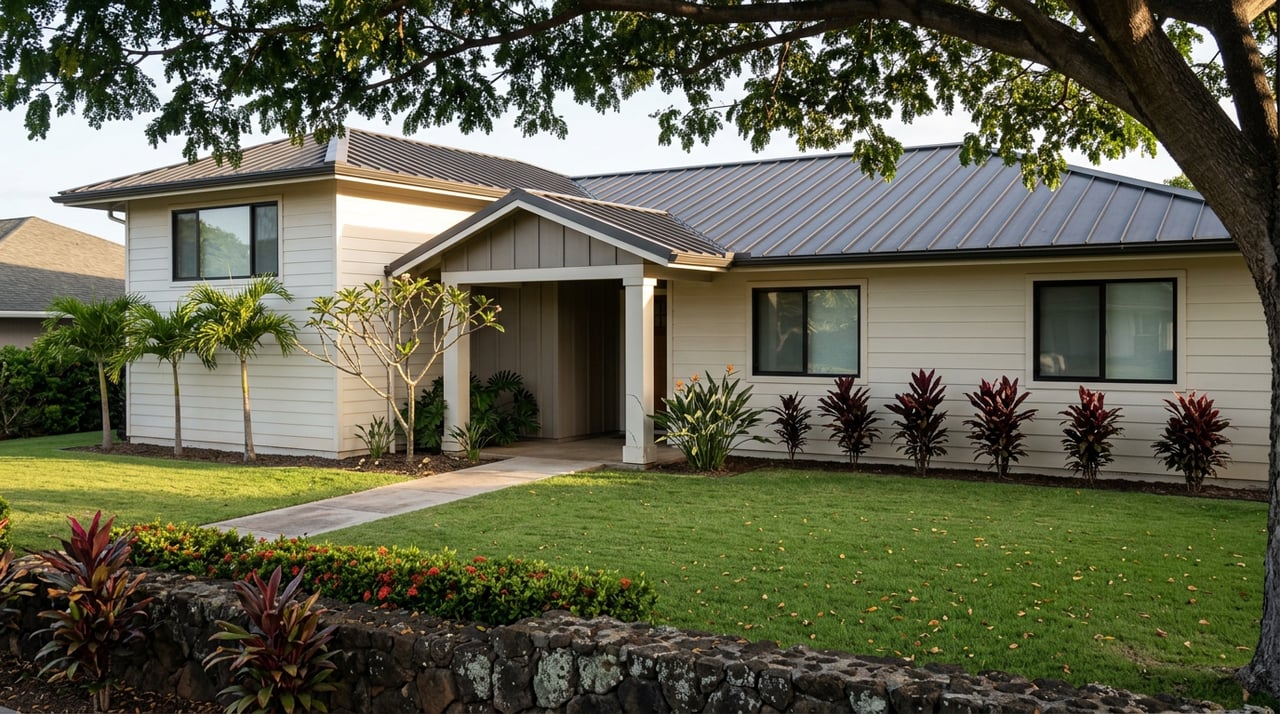
Across Oahu, the median single-family home sale price climbed to $1,213,500 in July 2026, up 13 percent from a year earlier, with homes typically going under contract in just 16 days. If you've been watching the island market from the mainland, that's the headline you've seen. It says the market is tight, competitive, and still climbing.
Ahuimanu didn't get that memo. Over the three months ending in June 2026, the median sale price for a home there was $1.1 million, down 1.7 percent from the year before. Homes sat for a median of 59 days, not 16. And yet the price per square foot in that same window rose 37.2 percent year over year, to $784. A neighborhood can't be getting both cheaper and more expensive at the same time. So what's actually happening.
One Name, Three Different Decades of Ahuimanu
The answer starts with something that doesn't show up on a portal search filter: Ahuimanu isn't one subdivision. It's three, built roughly a generation apart, all filed under the same MLS neighborhood name.
- Ahuimanu Area, the original tract along Kamehameha Highway between Valley of the Temples and Kahaluu, dates to the 1950s. Lots here run under a mix of residential, country, and agricultural zoning, and the homes are older, smaller, and less consistently updated.
- Ahuimanu Hills, sitting just west of the temple grounds, went up in the 1980s. Lots tend to be larger, several sit on cul-de-sacs, and the housing stock has had three or four decades to accumulate renovations.
- Ahuimanu Knolls, further west still, was built out in the 1990s and represents the newest core of the neighborhood, with layouts and finishes that read more like a current build than a legacy one.
None of that shows up when a listing simply says "Ahuimanu." A buyer scanning the neighborhood median has no way of knowing whether the comps behind that number are 1950s cottages or 1990s two-story homes with owned photovoltaic systems, unless someone tells them.
What A Composition Shift Actually Looks Like
This is where the math resolves. When a neighborhood median falls while its price per square foot climbs, the two numbers are usually reacting to the same underlying event from different angles: a change in what is selling, not a change in what any given home is worth.
Picture two sales in the same three-month window. One is a newly built two-story custom home, several bedrooms, high-end finishes, and it goes under contract in about a week. The other is an original three-bedroom, one-bath home on a quiet cul-de-sac, priced under a million dollars, and it takes several weeks longer to find a buyer. Both count as "an Ahuimanu sale." If more of the recent transaction volume skewed toward the newer, smaller-footprint, higher-finish end of the range, and fewer of the larger legacy homes changed hands, the price per square foot on paper rises even while the sale prices themselves land lower. That's not appreciation. It's a shift in the mix of what got sold.
The days-on-market number backs this up. A median of 59 days, up from 50 a year ago, isn't the signature of a neighborhood where everything is moving fast and prices are compounding. It's the signature of a market where certain segments are still finding buyers quickly and others are taking longer, which is exactly what you'd expect if three different housing vintages are being priced and marketed as one.
The Ahuimanu HOA is active in the original Ahuimanu Area subdivision
Why This Matters More Here Than In Most Oahu Neighborhoods
Every Oahu neighborhood has some spread between its oldest and newest housing stock. What makes Ahuimanu worth a second look is how cleanly that spread lines up with three distinct, named, decade-built tracts, rather than a gradual mix of renovation years scattered across one continuous subdivision.
If you're comparing Ahuimanu to Kaneohe proper or to Kailua on median price alone, you're comparing a blended number that could be masking a 1950s home, a 1980s home, or a 1990s home behind the same label. The practical move is to ask which pocket a specific listing sits in, when that pocket was built out, and whether it falls under the Ahuimanu Area HOA, before treating the neighborhood median as a stand-in for what a particular house is actually worth.
For sellers, the implication runs the other direction. If your home sits in the original Ahuimanu Area and a nearby Knolls listing just closed at a strong price per square foot, that comp may not translate the way it looks like it should. The vintage, the lot zoning, and the HOA structure all factor into what a buyer's lender and appraiser will actually support, and a pricing strategy built off the wrong comp set can leave real money on the table or stall a listing for weeks longer than it needs to.
What This Looks Like In Practice
None of this means Ahuimanu is a weak market. Nineteen homes sold there in June 2026, up from 16 a year earlier, so activity is moving in the right direction even as the median cooled. It means the neighborhood-level number is a starting point, not a conclusion, and the decade a specific home was built tells you more about its likely price per square foot than the neighborhood name on the listing does.
That's true whether you're comparing Ahuimanu to other windward communities before making an offer, or you're already living in one of its three tracts and trying to figure out what your own home is actually worth in a market that's sending two different signals at once.
A Few Questions Worth Asking Before You Compare Ahuimanu To Anywhere Else
If price per square foot is up 37 percent, does that mean home values are rising that fast? Not on its own. A composition shift, meaning a change in which vintage of home is selling in a given window, can push the per-square-foot figure up even while the overall median sale price moves in the opposite direction, as it did in Ahuimanu over the past year. The two numbers need to be read together, not separately.
Where To Go From Here
Numbers like these are exactly why a neighborhood-level median is a starting point for a conversation, not the end of one. If you're weighing Ahuimanu against another windward community, or trying to price a home in one of its three tracts correctly, Don Dietz has spent more than three decades working these micro-markets street by street. Schedule a free consultation and get a comp set built around the specific pocket of Ahuimanu you're actually looking at, not the blended average that shows up on a portal search.
This article is general information, not legal, tax or financial advice. Consult a qualified professional about your situation.